
Running · July 15, 2026
Being Consistent
A personal running journey about learning patience, building consistency, and turning a difficult 5K goal into steady progress.
Story
I recently started taking running seriously. Before that, I ran occasionally, more because I felt like it than because I was trying to improve. I did not measure progress in any meaningful way. I did not think much about pace, heart rate, recovery, or what one run was supposed to build for the next one. I simply went out when I had the energy for it. This summer felt different. Running became a real hobby, and slowly it became part of my longer 2026 fitness journey. I wanted to build a hybrid athlete body, improve my cardiovascular health, raise my VO2 Max, lose body fat, and become healthier in a way that could last. More than anything, I wanted running to become something I could enjoy for life, not just a short project built around quick results.
I had tried to begin the same journey last year, but I failed. Looking back now, it is easy to see why. I started too hard from the first day, began almost every run too fast, and tried to hold paces my body was not ready for. During 5K attempts, I refused to walk even when my heart rate climbed and my legs were clearly asking for a break. I treated almost every run like a personal record attempt. Recovery was an afterthought. I did not understand pacing, ignored heart-rate zones, and had running data on my watch without really listening to it. There was no long-term plan, only the hope that progress would appear quickly because I was motivated. Motivation helped me start, but it was not enough. What I was missing was patience.
This year I changed the plan. I stopped chasing speed first and focused on consistency. The first week was almost deliberately simple. I walked every day, usually between 5 km and 10 km, and tried to reach roughly 10,000 steps daily. Before beginning this journey, my watch estimated my VO2 Max at around 32. It was not a number I was proud of, but it was an honest starting point. I was not trying to become faster in the first week. I was trying to become the kind of person who showed up every day without turning every session into a test.
During the second week, I kept walking. I walked a little faster than before, but I still avoided running. Part of me wanted to rush ahead, because walking can feel too quiet when your mind is already dreaming about 5K times and Strava progress. But that slower beginning helped me build trust with the process. It gave my body time to accept the new rhythm. By the third week, I started introducing running through run-and-walk intervals. I configured my running watch for Zone 2 training, and whenever my heart rate went above roughly 150 bpm, I switched back to walking. At the start, my heart rate climbed above 165 bpm almost immediately, even at an easy effort. That was humbling, but also useful. It showed me exactly how much aerobic fitness I still needed to build.
After the fourth week, I introduced one weekly 5K attempt. Friday became my 5K day. That was the only race effort of the week, a small checkpoint rather than the entire purpose of training. The rest of the week was for building the engine: walking, interval training, easy runs, longer slow runs, gym sessions, and recovery. I stopped trying to prove something every day. Balance became more important than intensity. The training started to feel less dramatic and more sustainable, which was probably the first sign that I was finally doing it properly.
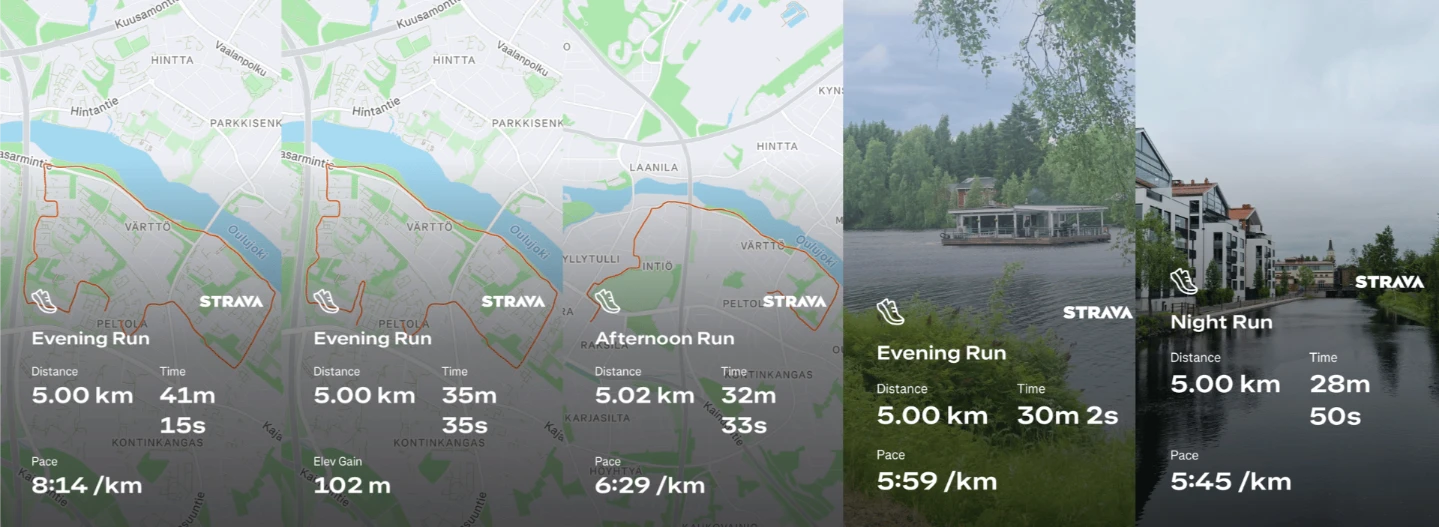
After approximately ten weeks, the progress became visible. My first 5K took 41 minutes. Then the time moved down to 35 minutes, then 32 minutes, then 30 minutes, and eventually 28 minutes. I achieved my annual goal of running a sub-30-minute 5K. The Strava progression looked simple on the screen, but it represented many quiet decisions that were easy to overlook: going out for another walk, slowing down when my heart rate was too high, resting instead of forcing another hard run, and accepting that one good week mattered less than many steady weeks.
The improvement was not only about effort. I worked on cadence drills, posture, recovery, and running economy. I learned how different running felt when I maintained a cadence above 160 instead of overstriding and fighting the ground. My form became more efficient. My breathing felt less chaotic. Even when my heart rate reached around 165-170 bpm during race efforts, I could stay more composed than before. It was still hard, but it no longer felt like my body was surprised by the work. Slowly, it had adapted because I kept giving it chances to adapt.
What stayed with me most was the way consistency changed my relationship with fitness. I am proud of the 28-minute 5K, but the better part was learning patience in a practical way. Patience meant going out again when progress was invisible. Discipline became less about pushing harder and more about returning to the plan without needing every day to feel impressive. I learned to celebrate small improvements: a lower heart rate at the same pace, a smoother stride, a better recovery day, a Friday attempt that felt controlled instead of desperate.
This running journey taught me that I do better when I respect the boring days. The real progress often arrived after weeks when nothing dramatic seemed to be happening. I kept walking, jogging, slowing down when the watch told me to, and taking recovery seriously. Then one day the numbers changed, and the body felt different. I want to keep that lesson close as I continue toward my 2026 fitness goals. Running feels less like something I am trying to conquer now, and more like something I am learning to live with. The work is quieter than I expected, and that is probably why it is beginning to last.
Share this entry
Share on LinkedInShare on XGallery